Getting it running
An hour, and almost all of it was aspect ratio. The game's rooms are composed for a square-ish display and stretching them to a modern widescreen does real violence to compositions that were clearly painted with care. Running it in its original proportions with borders is the only respectful option and takes a few minutes to configure. No crashes in fourteen hours.
The art is genuinely important
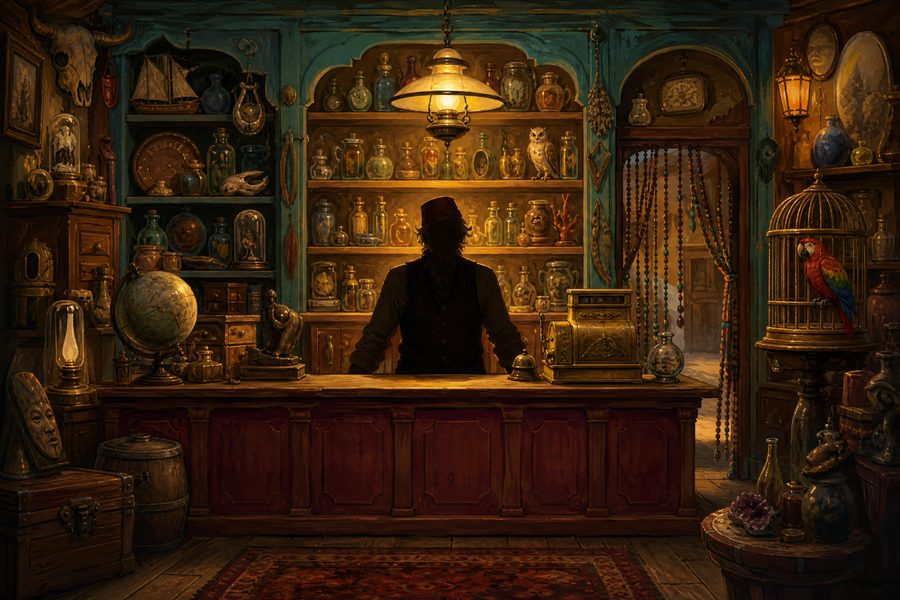
We want to be unambiguous about this before criticising anything: the backgrounds in The Curiosity Shop are among the best hand-painted work of their period, and at a modern resolution they hold up better than most three-dimensional art from a decade later. The shop interior alone contains dozens of objects that reward looking at, and the lighting — warm lamplight against deep shadow — creates an atmosphere that very few games have matched with vastly greater technical means.
The writing is also better than we expected. The shopkeeper's dialogue is dry, patient and occasionally genuinely funny, and the game trusts you to notice things rather than announcing them.
And then the puzzles
Two of them fail, and they fail in a way that is worth examining precisely because so many people have spent thirty years assuming the failure was theirs.
The first: the brass mechanism
To progress past the second act you must combine two objects whose only connection is a visual pun that works in one regional dialect of English and in no other. There is no in-game hint, no dialogue reference, and no object description pointing at it. We reconstructed the intended chain of reasoning and it requires a specific piece of linguistic knowledge that the game never establishes, never tests elsewhere, and never rewards again.
The second: the cage sequence
Worse, because it is timed. A required item can be permanently lost by performing a reasonable action in the wrong order, and the game does not tell you this has happened. It allows you to continue for roughly two hours in an unwinnable state before you encounter the door you can no longer open. We reached that door, could not establish why, and had to consult a walkthrough to learn that the run had been dead since long before.
A puzzle that can only be solved by knowing something the game never taught is not difficult. It is broken, and the fact that a generation of players blamed themselves for it does not make it otherwise.
What the reputation is actually about
Having played it, our conclusion is that the affection people hold for The Curiosity Shop is affection for its atmosphere, and that affection is entirely earned. What almost nobody remembers is the specific texture of being stuck for six hours, because being stuck is exactly the kind of experience memory discards. The rooms stayed; the frustration evaporated.
This is the pattern we encounter most often on this bench, and it is the reason we finish everything we review. Fourteen hours in this game contains perhaps five hours of the thing people love and a great deal of clicking every object against every other object in the hope of a reaction.
| Bench record | Result |
|---|---|
| Setup time | 1 hour, aspect ratio configuration |
| Playthrough | 14h to completion |
| Guidance consulted | Twice, both times unavoidably |
| Unwinnable states possible | Yes, at least one, silently |
| Modern display | Excellent in original proportions; do not stretch it |
| Stability | No crashes |
Verdict
Play it for the rooms, with a walkthrough beside you and no shame about using it. As a piece of illustrated atmosphere it deserves its standing; as a game to solve it does not, and the honest grade has to account for the fact that finishing it unaided is a matter of luck rather than reasoning.
If the developers of this era had been able to patch, we suspect both offending puzzles would have been changed within a month. They could not, and so the game is preserved exactly as it was, including the two mistakes.